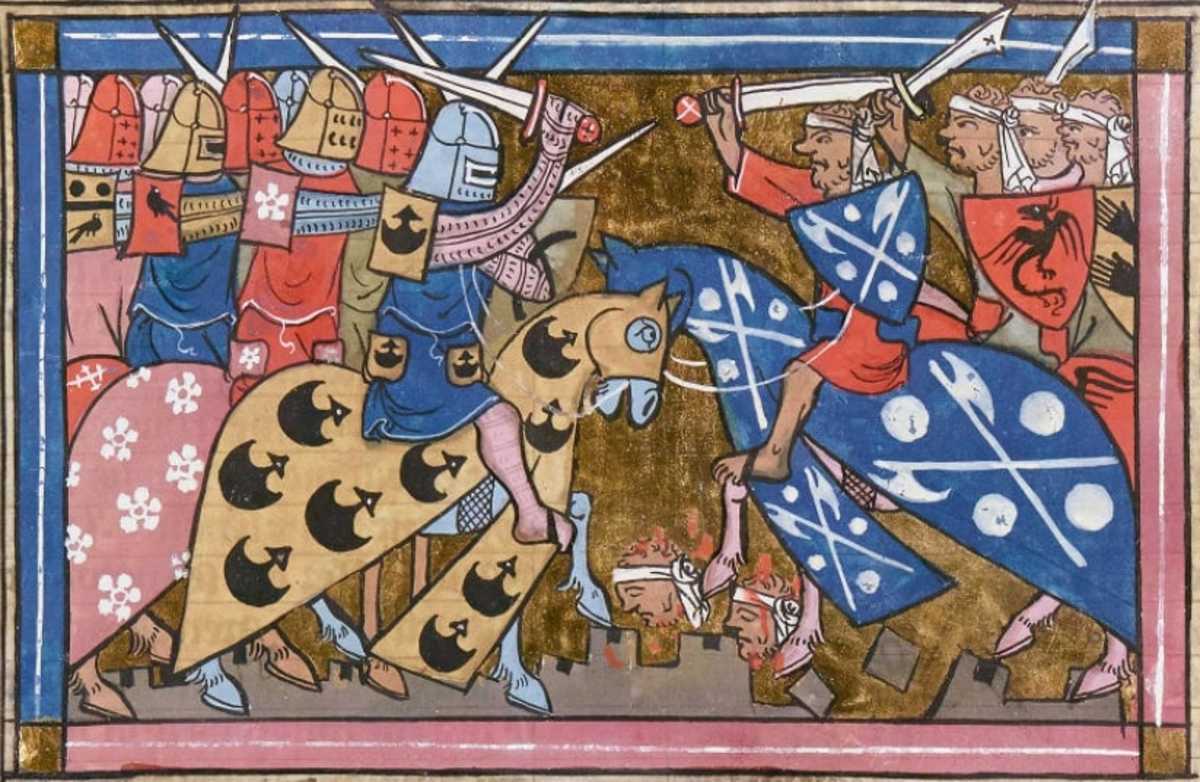
In Pilgrims and Strangers, a character goes on crusade in 1190 (aka the Third Crusade). But why this crusade and not others? My research shows this to be the most credible crusade to send my English character on. In a series of blogs, I'll explore the English participation in the Crusades up to 1230.
So, when did the English take part in the Crusades?
The participation of the English baronage in crusading to the East varied during the period 1096 and 1241. The Anglo-Saxon Chronicles report in 1096 that 'there was a very great stir throughout all this nation and in many other nations ... [and] countless people set out because they wanted to war against the heathen nations.' However, few English barons appear to have taken the cross. Similarly, there is little evidence of large-scale interest by the English elite in the Second Crusade contrary to contemporary accounts: 'you would have thought England was empty and drained of men when so many, and of such importance, were setting out' (Gesta Stephani).
The first substantial English involvement in crusading to the East did not occur until 1189 and was repeated for the Fifth Crusade. Participation remained inconsistent though - there is no evidence of any English baron taking part in the 1204 crusade nor do many join Frederick II in 1227.
How large were the English crusading armies?
Chroniclers provide the only evidence of the size of English crusading armies and must be viewed with a degree of scepticism. Richard I's forces, which arrived at Marseilles in July 1190, realistically could have numbered 6,000 men, not the reported 100,000 (J.B. Gillingham). Richard Devizes estimates Richard's fleet of 100 ships, which was to meet him at Marseilles, carried a further 8750 soldiers and sailors. Ralph of Diceto writes that a separate fleet, which left Dartmouth in May 1189, took 3,500 English, Danish and Flemish crusaders to the Holy Land. With Richard I's domains stretching to the Pyrenees, it is impossible to know how many of these crusaders were English or held lands in England. However, using the figures above as an estimate, up to 18,250 Englishmen participated in the Third Crusade.
What proportion of the population went on Crusade?
Even during the crusades which had an increased English response, the percentage of the population who went to the East was comparatively small. The population figures for England during this period can be no more than guesses, made more plausible by information provided in the Domesday Book. Historians have estimated that the total English population in 1086 was 2,250,000. If this figure is taken alongside an annual rate of growth of 0.65% during the twelfth and thirteenth centuries, the population in England can be calculated as being around 4,385,000 in 1189. Thus approximately 4% of the total population of England participated in the Third Crusade.
To gauge the level of involvement by the elite of society is difficult with the sources available and without an in-depth study. Of the forty five tenants-in-chief whose servitium debita to the king was twenty fees or more in 1166, nine (20%) went on the Third Crusade. A similar proportion of high ranking men were involved in the Fifth Crusade with eleven (25%) departing for Damietta.
This small study is not conclusive and in certain instances the figues used can be no more than hypothetical. However, it does seem to indicate that only a fraction of the English population went to the Holy Land even during the crusades which saw increased English involvement. The call for crusade appealed to the barons with a large number of high ranking men departing for the East. It should be noted though, that the majority stayed at home.