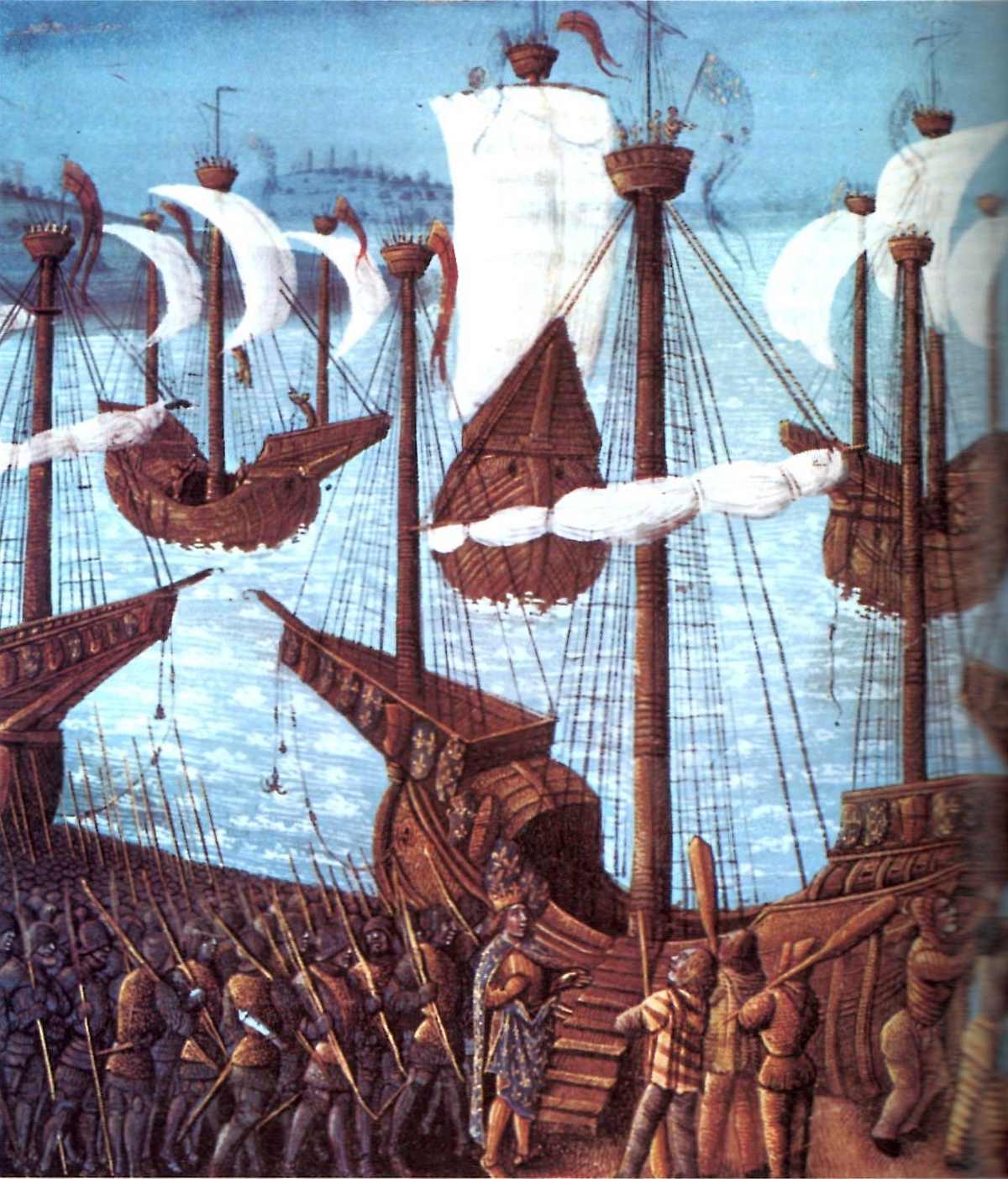
In Pilgrims and Strangers a character goes on crusade in 1190 (aka the Third Crusade). Although not part of the novel, my character's back story is that he took the Cross in 1188 during Archbishop Baldwin's (of Canterbury) preaching campaign, two years before his departure. In part four of a series of blogs, I look at why such a delay was common.
The delay in the time between taking the cross and the departure of the English contingents can be partly explained by the need to raise capital to fund such an expedition and other logistical preparations. However, the main cause for delayed departure was secular politics.
The Third Crusade
Many barons took the cross in 1188 and 1189, but failed to leave for nearly two years. The fighting between Henry II, his son, Richard, and Phillip II, the death of Henry II, and the accession of Richard I created uncertain political times. It was only when Richard I was ready to leave on crusade that barons felt confident that it was safe for them to leave too.
The Fifth Crusade
The civil war in England in 1216-17 and its aftermath dictated when English barons departed for the East. Many rebels suffered disseisin of their lands which were granted to royal supporters during the war. Part of the peace process was the return of these lands and the re-establishment of the rebel barons into political life. Moreover, the period immediately after the civil war found the government of the minority in a weakened position with barons taking advantage of this to further their own ambitions. Their secular concerns came first; only when these were secure could the barons consider fulfilling their crusading vows.
The loyalist Earl of Chester expanded his power base greatly during and after the civil war. Before his departure he sought to protect his gains from the minority government by making his bailiffs swear to 'keep his castles safe for the king's use until he comes of age.' If one of his under-sheriffs should die while he was away, another was to be chosen by his fideles, not central government (D. A. Carpenter, The Minority of Henry III ).
Richard fitz Regis did not leave for the East until he was forced to surrender Wallingford Castle in April 1220. He ensured an agreement was made whereby he remained sheriff of Berkshire and that he would recover the castle if he returned before the king came of age.
The Earl of Salisbury does not appear to have felt as confident in the safety of his various contested acquisitions while he fulfilled his crusading vow. His crusade lasted less than a year - possibly between August 1218 when he was told not to tourney and August 1219 when he attempted to force his way into Lincoln Castle and expel the castellan. He barely left enough time to complete the return journey to Damietta, let alone make any effective contribution to the crusading effort.
Many rebel barons delayed their crusade until they felt assured of their political position. Saer de Quincy received patronage at the October council in 1217 and was one of the barons who attested the Treaty of Worcester in March 1218. He, along with Robert fitz Walter and the Earl of Arundal, stood surety for the release of John de Braose and his brothers in January 1218. The Earl of Arundal was appointed as a senior judge, one of the highest positions in government, in October 1218 and sat on the bench for nearly all the Michaelmas term. In November 1218 Stephen Langton attested royal letters in the presence of the Earl of Arundal and Robert fitz Walter. All three men departed for the East in spring 1219 now they were fully rehabilitated into political life to an acceptable level.
The staggered departure of many crusader barons can be linked to the security of their lands and their restitution in secular politics. Personal power was the barons' first and foremost concern.